NAMs are reshaping biomedical research, but they do not fully replicate the complexity of living biological systems… yet. Current NAMs reduce animal use and work side by side with animal studies to deliver more complete answers.
New Alternative Methods
Emerging tools reshaping how researchers study biology, disease, and safety, working alongside animal studies on the path to tomorrow’s breakthroughs.
The Future of Biomedical Research
What are NAMs?
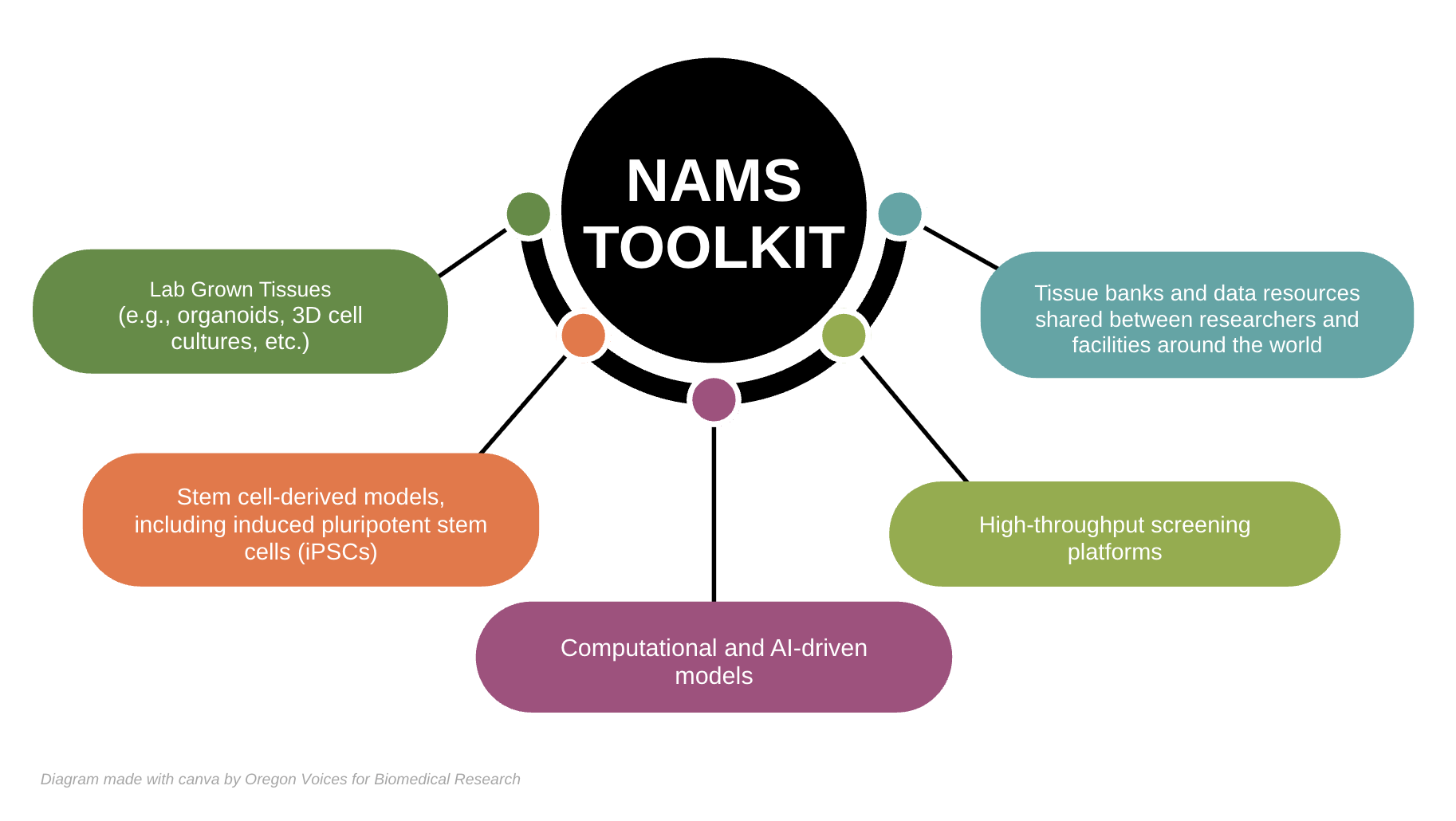
New Approach Methodologies, or NAMs, are a growing category of research tools that study biology without relying on live animals. In 2022, the National Academies of Sciences, Engineering, and Medicine officially defined NAMs as technologies and approaches (which included computational models, in vitro assays, and tests using less sentient species) that can inform hazard and risk assessment decisions without the use of animal research.
Taken together, this growing list of tools allow researchers to ask biological questions faster, often using human-derived cells and tissues.
Why NAMs Are Important
NAMs provide a variety of benefits to biomedical research. Studying human cells and tissues directly generates insights with clearer application to human health. Computational models can analyze datasets larger than any wet lab could handle. And automated platforms run experiments in days that once took months. There is, of course, an ethical component to consider. Moving toward methods that do not rely on animals is a goal widely shared across the scientific community, and NAMs sit squarely within the long-established 3Rs framework: Replace, Reduce, and Refine animal studies wherever possible.
Recently, federal agencies have taken notice as well. The National Institutes of Health has made NAMs a major investment priority, and the FDA Modernization Act 2.0 (signed in 2022) allows drug sponsors to use validated non-animal methods in place of certain animal studies for FDA approval. These developments signal a future where NAMs shoulder more of the work, even as the science continues to mature.
Why Animal Studies Remain Essential
When people first learn about NAMs, there is often an assumption that they are ready to replace animal research entirely. That day may come, but the science is not there yet. Living organisms are remarkably complex: organs communicate with one another, the immune system responds to changes elsewhere in the body, hormones and metabolism operate on their own feedback loops, and every system adjusts in real time. Even the most advanced in vitro system is unable to reproduce all of those interactions working together.
Regulatory Requirements
Some research must take place in animals before treatments can move into human clinical trials.
NAM Validation
NAMs themselves must be scientifically validated, and in many cases that validation depends on data generated through animal studies.
Whole-System Biology
Diseases like Alzheimer’s, Parkinson’s, diabetes, and infectious diseases require system-level understanding that current non-animal methods cannot yet provide.
AI Needs Biological Data
Artificial intelligence and computational models rely on biological data for training, and that data must be validated, often through animal models.
Animal Models and NAMs: Partners, Not Competitors
Animal models and NAMs have been a popular topic of discussion in the scientific community over the past few years and, on occasion, they have been portrayed as opposing forces in biomedical research, but that framing is misguided. Many in the scientific community recognize that animal research and NAMs are not competing ideologies, but rather complementary tools; both aim towards the same foundational goal: advancing safe, effective treatments for humans and animals alike. The vaccines, surgical techniques, and therapies developed through animal research have extended and improved lives across species, from the dogs and cats in our homes to wildlife populations around the world.
Instead of one method displacing another, what we are witnessing is an evolution in which today’s biomedical research produces the biological knowledge and validated benchmarks that make tomorrow’s alternatives possible. This is science doing what it does best: building smarter, more humane tools, one discovery at a time.
The Journey Ahead
NAMs symbolize a genuine shift in biomedical research, and the momentum is real. The goal of significantly reducing animal use is widely supported, and investment in these tools continues to grow.
However, getting there responsibly is extremely important.
Developing NAMs requires careful validation and rigorous characterization alongside animal models to confirm that new tools can reliably predict real-world outcomes in a complex organism. Rushing that process, especially by relying solely on AI and computational models (also known as in silico methods), could compromise human safety and scientific integrity.
Animal studies and NAMs are walking the path of scientific progress hand in hand, and today’s studies, whether in animals or in advanced in vitro systems, are laying the groundwork for tomorrow’s breakthroughs.
NAMs Research in Oregon
Oregon researchers have been part of the national NAMs effort for over a decade, contributing to tools used by scientists worldwide.Their work reflects the same principle at the heart of NAMs nationally: better science through better tools, advanced alongside animal research rather than in opposition to it. Examples include: