The majority of research institutions are federally funded or AAALAC accredited, both of which require animal study proposals to go through a scientific review panel for approval and grant funding. Once the study is accepted, it must then pass through one of the most thorough review processes in all of science. Most people have never heard of the committee responsible for this review, yet it plays a critical role in protecting animal welfare at research institutions across the country. It’s called the Institutional Animal Care and Use Committee, or IACUC, and understanding what it does can change the way you think about how research with animals is regulated and conducted.
So what exactly is an IACUC, who sits on one, and what do they do? Let’s take a closer look at one of the most important and least understood safeguards in biomedical research.
What Is an IACUC?
An IACUC is a federally mandated committee that exists at every institution in the United States receiving federal funding that teaches or conducts research involving animals. The committee’s job is to review, approve, and monitor all activities involving animals to make sure they comply with federal laws, regulations, standards of veterinary care, and institutional policies.
IACUCs are required by two key authorities:
- The Animal Welfare Act (AWA) and Regulations (AWR), enforced by the U.S. Department of Agriculture (USDA)
- The Policy on Humane Care and Use of Laboratory Animals, issued by the U.S. Public Health Service (PHS)
Together, these regulations ensure that no live animal research can be conducted without the committee’s approval.

U.S. Department of Agriculture, Animal and Plant Health Inspection Service. (2023). Cover of the Animal Welfare Act and Animal Welfare Regulations (APHIS 41-35-076) [Image]. https://www.aphis.usda.gov/media/document/17164/file
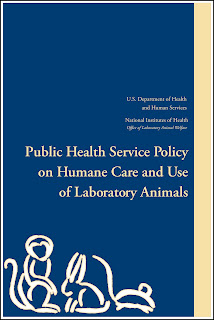
U.S. Department of Health and Human Services, National Institutes of Health, Office of Laboratory Animal Welfare. (2015). Cover of the Public Health Service policy on humane care and use of laboratory animals [Image]. https://olaw.nih.gov/policies-laws/phs-policy.htm
Who Serves on an IACUC?
One of the most important features of an IACUC is its diverse membership. The PHS Policy dictates that the committee must include, at a minimum:
- A veterinarian with experience in laboratory animal medicine, who can evaluate whether research procedures are humane and appropriate.
- A practicing scientist who is experienced with animal research and can assess the scientific merit of proposed procedures and study goals.
- A nonscientist member whose primary expertise lies outside science. This individual could be an ethicist, a member of the clergy, a lawyer, etc. This person brings a perspective grounded in ethics and public values rather than technical research.
- A community representative who is unaffiliated with the institution in any way. This individual serves as the voice of the broader public, helping to ensure that the review process reflects community concerns and values.
Many institutions go well beyond these minimum requirements, some with committees of 15 to 20 or more members, bringing in additional experts from specific areas of research to broaden the scope of their review

What Does an IACUC Actually Review?
Before any study involving animals can begin, it must pass through the IACUC’s rigorous review process. The committee evaluates every proposed project against a demanding set of criteria. There are five critical elements to this review:
- Species justification and alternatives. Researchers must explain why their work requires the particular species they’ve chosen, whether alternative methods, such as cell-based studies, could answer the same question, and why the requested number of animals is necessary for statistical rigor and reproducibility. This must be accomplished by a search of the current scientific literature for less invasive procedure techniques and alternatives.
- Detailed procedural descriptions. Scientists must lay out exactly what they plan to do with the animals, whether that involves surgical procedures, the administration of experimental drugs, or behavioral testing. This must include frequency of procedures, volumes/doses of agents, and all post-procedure care and monitoring.
- Justification and pain minimization. Any procedure that could cause pain or distress requires scientific justification and a detailed plan for how the researchers will minimize and monitor it.
- No unnecessary duplication. The proposed research must not unnecessarily repeat work that has already been done. Scientists must describe the information sources they used to confirm this and to determine that no alternatives exist for any potentially painful procedures.
- Personnel qualifications. All staff involved in the project must be listed, and the researcher must document that each person is properly trained for the work they will perform.
In short, the IACUC doesn’t just rubber-stamp proposals. It asks hard questions, often requires modifications, and has the authority to reject studies that don’t meet its standards or suspend studies with significant adverse events.

The Ethical Framework: The 3Rs
Underpinning the work of every IACUC is an ethical framework known as the 3Rs: Replacement, Reduction, and Refinement. First published in 1959 by British scientists William Russell and Rex Burch, these principles guide the research community’s approach to animals in science (Hubrecht & Carter, 2019).
- Replacement challenges researchers to consider whether animal models can be avoided entirely, for instance, by using cell cultures, computer models, or organ-on-a-chip technology instead.
- Reduction is about doing more with less. By using as few animals as possible while still achieving scientifically valid results through careful design and statistical analysis.
- Refinement focuses on improving procedures to minimize pain, distress, and suffering, covering everything from anesthesia and pain management to enriched housing and low-stress handling techniques.
The 3Rs are now embedded in regulations and institutional policies worldwide, and IACUCs apply them in every study they evaluate.

Image created using Biorender
Beyond the IACUC: Multiple Layers of Oversight
It’s worth noting that the IACUC is just one part of a much larger oversight ecosystem. Biomedical research involving animals is among the most heavily regulated activities in science, with multiple independent bodies watching over it:
- The USDA conducts unannounced inspections of all facilities covered under the Animal Welfare Act at least once per year. The agency operates under a zero-tolerance policy, meaning every infraction, no matter how minor, results in a citation, even if the facility has previously reported it to the appropriate regulatory agency.
- The NIH’s Office of Laboratory Animal Welfare (OLAW) oversees compliance with PHS Policy for all NIH-funded facilities. OLAW reviews reports of noncompliance and has the authority to suspend an institution’s NIH funding if serious welfare concerns are identified.
- AAALAC International (the Association for Assessment and Accreditation of Laboratory Animal Care) offers voluntary accreditation that goes beyond regulatory requirements, similar to the voluntary accreditation programs for zoos (e.g., the Association of Zoos & Aquariums, AZA) or veterinary hospitals (e.g., the American Animal Hospital Association, AAHA). It is considered the gold standard for laboratory animal care. Seeking AAALAC accreditation signals a genuine commitment to doing things right and striving for the highest standards of care for the animals, the science, and the staff.
- Attending veterinarians at each facility have the legal authority to oversee the health and well-being of all research animals, including the power to temporarily halt a study, pending IACUC review, if animal welfare concerns arise.
After a study is approved, oversight doesn’t stop. Post-approval monitoring ensures that research continues to meet ethical and regulatory standards throughout its duration. Any serious incidents are reported to institutional officials, the IACUC, and the relevant federal agencies. Studies also have to seek renewal of their approval every three years and provide progress updates to the committee.
Want to Learn More?
Curious about how these oversight systems work in practice? Check out related blog posts on our site, or reach out to learn more about biomedical research oversight in your community.
References
Hubrecht, R. C., & Carter, E. (2019). The 3Rs and humane experimental technique: Implementing change. Animals, 9(10), 754. https://doi.org/10.3390/ani9100754
NC3Rs (National Centre for the Replacement, Refinement and Reduction of Animals in Research). (n.d.). The 3Rs. Retrieved from https://nc3rs.org.uk/who-we-are/3rs
Russell, W. M. S., & Burch, R. L. (1959). The principles of humane experimental technique. London: Methuen.
U.S. Department of Agriculture, Animal and Plant Health Inspection Service. (2023). Animal Welfare Act and Animal Welfare Regulations (APHIS 41-35-076). https://www.aphis.usda.gov/media/document/17164/file
U.S. Department of Health and Human Services, National Institutes of Health, Office of Laboratory Animal Welfare. (2015). Public Health Service policy on humane care and use of laboratory animals (NIH Publication No. 15-8013). https://olaw.nih.gov/sites/default/files/PHSPolicyLabAnimals.pdf