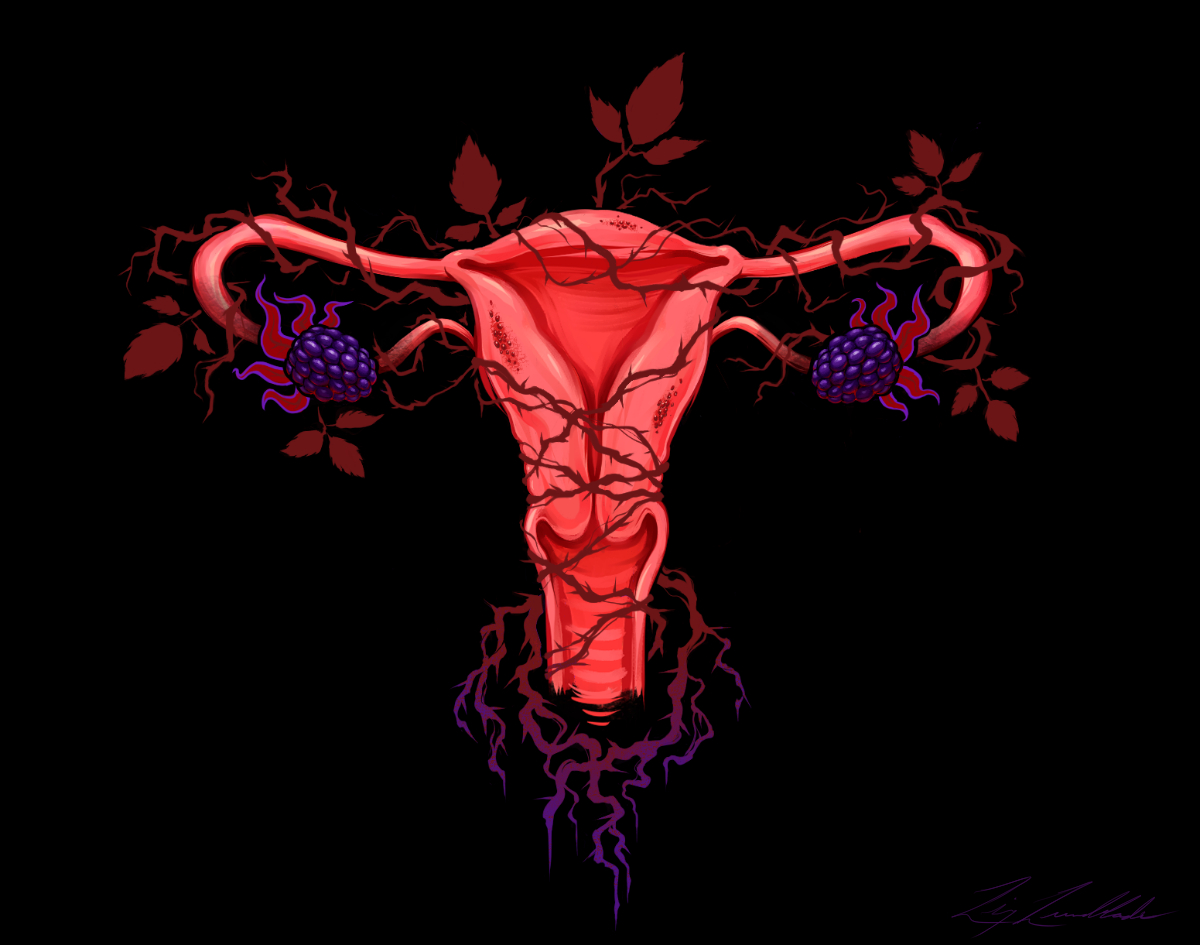
Illustration by Liz Lundblade
Living with severe endometriosis has shaped every part of my life. The pain has sent me to the emergency room as many as ten times a year. Over the past 21 years, I’ve undergone 16 surgeries and tried nearly every hormone treatment available, hoping something would finally bring relief. Some days, I can only walk a few steps. Even after having my uterus and ovaries removed, the pain is still there, but the physical pain is only part of the story.
The pain itself is hard to describe unless you’ve lived it. At times, my entire pelvic region feels inflamed, like lava is spilling through my body, causing a deep burning and aching sensation. Other times, it feels like I’m being stabbed repeatedly, relentlessly. There are moments when it hurts to breathe, and even the smallest movement can feel unbearable.
Because of this, it’s hard to do everyday things, especially being present the way I want to be with my kids. There are days when I can’t play with them, can’t move freely, and can’t show up as the parent I want to be. That loss is heartbreaking.
Endometriosis has also taken a toll on my mental health. Living with constant, unpredictable pain can lead to anxiety, depression, and a deep sense of isolation. It’s difficult to make plans, maintain stability, or feel in control of your own life when your body can betray you at any moment.
It has also affected my relationships. Friends and family don’t always understand the severity of the condition, especially because it’s an invisible illness. There are missed events, canceled plans, and moments where I simply can’t show up the way I want to. Romantic relationships can be especially challenging when pain interferes with intimacy and connection.
Maintaining a job can feel nearly impossible at times. Chronic pain doesn’t follow a schedule, and many workplaces aren’t equipped to accommodate that reality. For many of us, this creates financial strain on top of everything else.
To cope, many people with endometriosis rely on pain medication just to function. Unfortunately, they are often judged or stigmatized by medical professionals for seeking relief. Let me be clear: we are not drug seekers—we are people in legitimate, often debilitating pain. We want our pain to be gone. We want to live our lives.
The reality is that women with endometriosis are significantly more likely to develop chronic opioid use—not because of misuse, but because the pain is relentless and long-lasting. At the same time, many of us do not want to rely on pain medications or undergo repeated surgeries. We want better treatments that actually address the disease, not just manage the symptoms.
Endometriosis can also take away the possibility of having children. Many women face infertility because of this condition, adding another layer of grief and loss to an already difficult journey.
My experience led me to start a nonprofit organization, Sisters Helping Sisters. I created it after losing a close friend to suicide. She was overwhelmed by her endometriosis pain and couldn’t access affordable medical care. No one should have to face that kind of suffering alone.
Through Sisters Helping Sisters, we provide financial support for medical treatments so others can access the care they need and deserve.
I’m also a strong advocate for better, more accessible treatment options. The research being conducted at the Oregon National Primate Research Center gives me real hope. They are working toward a non-hormonal, non-surgical treatment for endometriosis, something that could change lives.
This matters because hormones don’t work for everyone and often come with difficult side effects, including impacts on mood and energy. Surgery, while helpful for some, is expensive, risky, and not always effective. Many people, like me, continue to experience pain even after extensive surgical procedures.
We need more options. We need real solutions.
I urge you to support this research by reaching out to the Oregon Health & Science University Board of Directors, as well as your local and state representatives. Let them know that this research matters—that lives depend on it.
If you would like to support women living with endometriosis or learn more about our work, please visit: Sisters Helping Sisters
No one should endure this alone.
Thank you,
Lovlin Geczy (Spokane, WA)