May is Mental Health Awareness Month, and most of the conversation rightly centers on humans. However, there is a quieter, parallel conversation happening inside research institutions across the country. How do we care for the psychological wellbeing of the animals who help advance biomedical science?
More thoroughly than one might guess.
Modern research facilities, particularly those that house nonhuman primates, have entire teams of specialists dedicated to ensuring their animals are not only physically healthy, but mentally healthy too. Their work is built on decades of behavioral science, and what they learn can translate back into better care for humans.
From Physical Care to Psychological Care
For decades, animal welfare in research focused on the animal’s physical needs: clean enclosures, good nutrition, freedom from disease, and effective pain management. Accredited institutions are now expected to look after welfare more broadly, covering not only nutrition, environment, and health but also behavior and mental state (Mellor et al., 2020). That broader view comes from a simple realization: animals, especially social mammals like monkeys, mice, and dogs, have real psychological needs. Boredom, isolation, and chronic stress show up in their behavior, their physiology, their immune function, and in how reliable any research involving them turns out to be (NC3Rs, n.d.). Treating animals well isn’t only the right thing to do. It also produces better, more reproducible science.
Meet The Behavior Teams
If you have never heard of a research behavior team, you are not alone. These specialists work quietly in the background, but they are central to how a modern research facility operates.
At the Oregon National Primate Research Center (ONPRC), the Division of Comparative Medicine includes a dedicated Behavioral Services Unit, one of eight units staffed by veterinarians, technicians, and behavioral scientists who work alongside investigators to keep animals physically and mentally healthy. Their day-to-day work includes:
- Designing enrichment programs. Food treats, puzzles, foraging toys, novel objects, and even touch-screen cognitive games keep animals mentally engaged. Enrichment isn’t just a nice addition to care; it is a requirement under federal animal welfare regulations.
- Managing social housing. Macaques are intensely social animals. Whenever possible, they live in pairs or groups, and behavior staff carefully evaluate compatibility so introductions go well.
- Training animals to participate in their own care. Through positive reinforcement, animals can be trained to voluntarily present a leg for a vaccination, sit calmly for an ultrasound, or step onto a scale. This dramatically reduces stress and is a centerpiece of what researchers call “Refinement” under the 3Rs framework.
- Monitoring for behavioral signs of stress or illness. A subtle change in eating, grooming, or social interaction can be the earliest indicator of a problem, often before any physical symptom appears.
Behavior teams are not unique to primate centers. Dogs in research facilities have dedicated handlers and socialization programs; mice are increasingly handled using low-stress techniques like tunnel handling; and even zebrafish researchers are paying close attention to environmental enrichment and tank conditions.
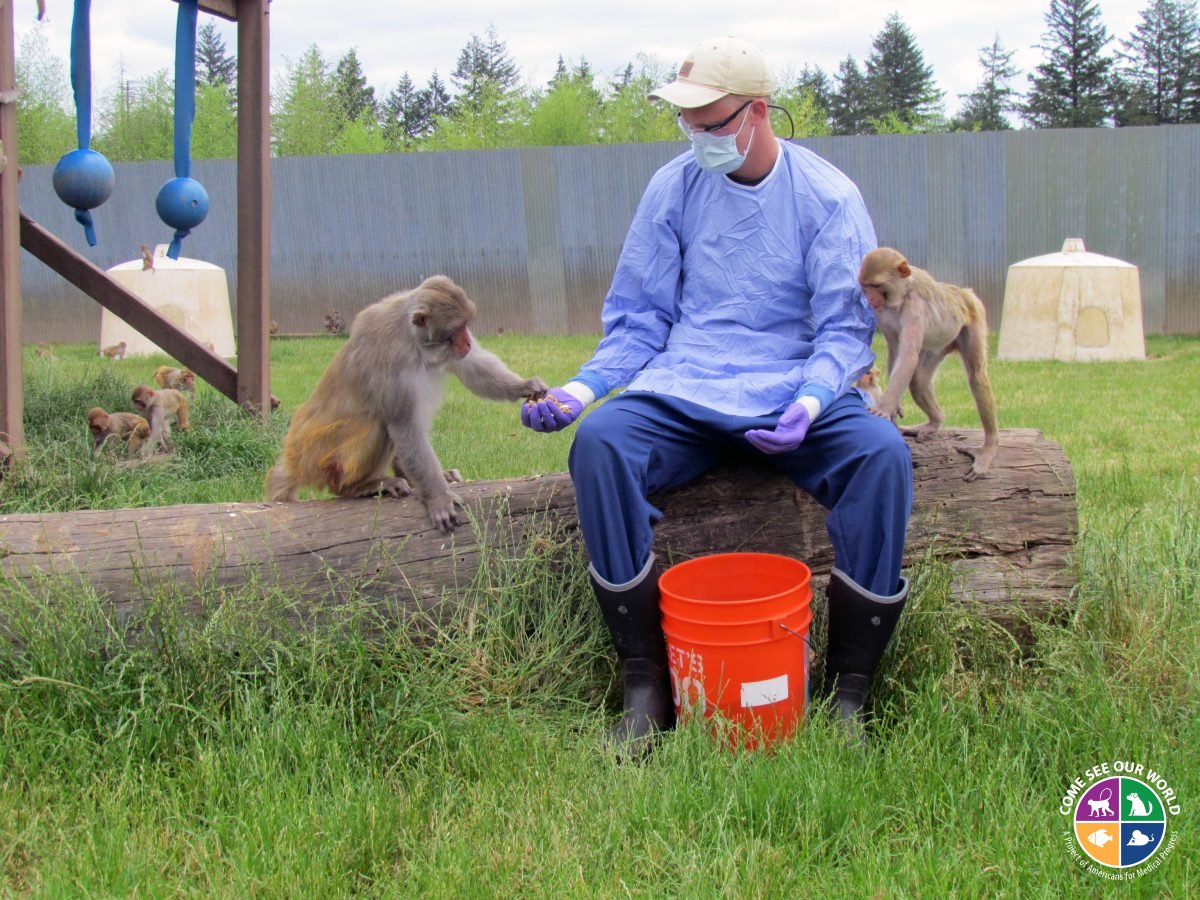
Husbandry staff provide food enrichment to rhesus macaques in their corral. Photo: Oregon National Primate Research Center/OHSU
Oregon Welfare Research That Is Shaping The Field
Some of the most interesting work happening in animal welfare science is being done right here in Oregon. Researchers at the ONPRC publish peer-reviewed studies that not only improve the lives of animals at the center; they also help shape how facilities worldwide care for their populations.
- Making pair housing work. Pair housing is one of the most important welfare interventions for macaques, but partner introductions do not always go smoothly. A team led by Drs. Kristine Coleman and Rhonda MacAllister identified specific early behaviors, such as proximity-seeking and tandem threats, that predict whether two animals will form a lasting bond (MacAllister et al., 2020). This research helps behavior staff make better pairing decisions and reduces stress and injury for the animals involved. Further, a recent study by Dr. Madeline Burke and colleagues showed that keeping animals socialized while they are being treated for illness or injury does not negatively impact healing time or increase disease transmission, removing significant arguments for single-housing animals during treatment (Burke et al., 2026).
- Better growth charts for healthy infants. Dr. Andrew Haertel and colleagues developed updated growth curves for infant rhesus macaques, giving caretakers a more accurate tool for identifying babies who may be failing to thrive (Haertel et al., 2018). Earlier intervention means healthier animals and stronger breeding colonies.
- Smarter pain management. Research at ONPRC has helped reduce side effects of sustained-release buprenorphine, a long-acting pain reliever, by identifying which animals are most at risk of injection-site reactions and recommending higher-concentration formulations that lower that risk (Haertel et al., 2021).
Taken together, these studies illustrate something important: animal welfare is an active, evolving area of biomedical science in its own right, not just a checklist of compliance items.
Welfare Science Beyond The Lab
Animal welfare science is also an interconnected field. Researchers who study laboratory animal welfare share their findings with veterinarians, zoo behaviorists, shelter staff, farm-animal specialists, and pet care professionals through conferences, peer-reviewed journals, and organizations such as the International Society for Applied Ethology. Insights about stress, enrichment, social housing, and low-stress handling rarely stay in one place. Advances in one corner of welfare science tend to spread, helping animals in many of the places people encounter them, from backyards and barns to zoos and shelters.
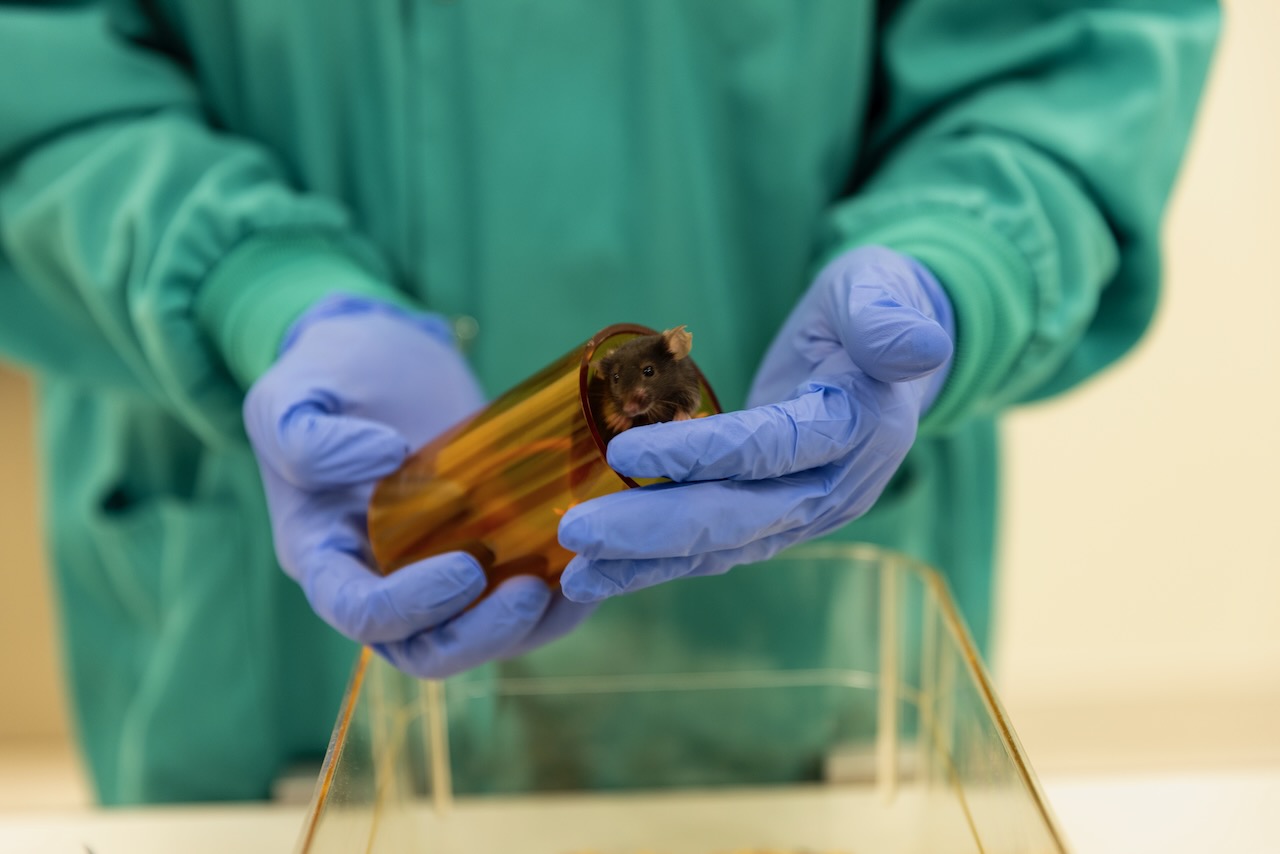
Mice are acclimated to tunnel handling, a low-stress way to move them between enclosures. Photo: University of Washington/Come See Our World
How Caring For Animals Helps Humans Too
The benefits of welfare and behavioral research can go both ways. Insights from animal studies can inform care for human patients, and at ONPRC, some of the most impactful mental health discoveries have come from this kind of translational science.
Some important early work happened decades ago. In the 1990s, ONPRC scientists, including Dr. Cynthia Bethea, were among the first to show how estrogen affects a chemical in the brain called serotonin. Serotonin helps control how we feel. Their research found that estrogen helps the brain make more serotonin (Pecins-Thompson et al., 1996). That discovery helped explain something doctors had noticed for a long time. Estrogen drops suddenly after a woman gives birth, and slowly during menopause. Those drops can make some women more likely to feel depressed. The early ONPRC research helped open the door to ongoing studies of how hormones shape mood. A more recent small study in patients, building on this work, has tested estrogen skin patches as a possible treatment for postpartum depression (Li et al., 2020).
Beyond this example, studies of how stress, social environment, and enrichment shape the brain in animals help researchers understand human conditions like depression, PTSD, and autism spectrum disorders. Animals are not stand-ins for human suffering, they are partners in understanding it.
The scientific community’s growing focus on animal mental wellbeing reflects and reinforces a broader cultural commitment to taking mental health seriously across species.
Why Mental Wellbeing Matters, For Every Species
Mental Health Awareness Month is a useful reminder that psychological wellbeing is not a luxury. It is a foundation of health for humans and animals alike.
The work behavior teams do every day (e.g., designing enrichment, building stable social groups, training animals to participate in their own care, monitoring for the earliest signs that something is off) reflects a powerful idea: When we treat animals as the complex, feeling beings they are, we make their lives better and the science they contribute to stronger.
It is a quiet kind of progress, and it matters.
Learn More
Curious about how animal welfare is regulated and enforced in research? The AAALAC International website explains the global accreditation system that holds research institutions accountable for animal care. You can also read our blog post on the 3Rs, the ethical framework that underpins humane research worldwide.
If this post resonated with you, share it during Mental Health Awareness Month, for the humans in your life, and for the animals working alongside our scientists.
A Note For Our Readers
If you or someone you know is struggling, support is available.
The 988 Suicide and Crisis Lifeline offers free, confidential support 24 hours a day, 7 days a week. Call or text 988, or chat online at 988lifeline.org.
For ongoing mental health information and support, visit the National Alliance on Mental Illness at nami.org, or Oregon’s Lines for Life.
References
Burke, M. C., Haertel, A. J., Heagerty, A., & Dozier, B. L. (2026). Effects of social pairing on measurable disease outcomes in hospitalized rhesus macaques (Macaca mulatta). American Journal of Primatology, 88(4), e70144. https://doi.org/10.1002/ajp.70144
Haertel, A. J., Prongay, K., Gao, L., Gottlieb, D. H., & Park, B. (2018). Standard growth and diarrhea-associated growth faltering in captive infant rhesus macaques (Macaca mulatta). American Journal of Primatology, 80(9), e22923. https://doi.org/10.1002/ajp.22923
Haertel, A. J., Schultz, M. A., Colgin, L. M., & Johnson, A. L. (2021). Predictors of subcutaneous injection site reactions to sustained-release buprenorphine in rhesus macaques (Macaca mulatta). Journal of the American Association for Laboratory Animal Science, 60(3), 329–336. https://doi.org/10.30802/AALAS-JAALAS-20-000118
Li, H. J., Martinez, P. E., Li, X., Schenkel, L. A., Nieman, L. K., Rubinow, D. R., & Schmidt, P. J. (2020). Transdermal estradiol for postpartum depression: Results from a pilot randomized, double-blind, placebo-controlled study. Archives of Women’s Mental Health, 23(3), 401–412. https://doi.org/10.1007/s00737-019-00991-3
MacAllister, R. P., Heagerty, A., & Coleman, K. (2020). Behavioral predictors of pairing success in rhesus macaques (Macaca mulatta). American Journal of Primatology, 82(1), e23081. https://doi.org/10.1002/ajp.23081
Mellor, D. J., Beausoleil, N. J., Littlewood, K. E., McLean, A. N., McGreevy, P. D., Jones, B., & Wilkins, C. (2020). The 2020 Five Domains Model: Including human–animal interactions in assessments of animal welfare. Animals, 10(10), 1870. https://doi.org/10.3390/ani10101870
National Centre for the Replacement, Refinement and Reduction of Animals in Research (NC3Rs). (n.d.). Refinement. https://nc3rs.org.uk/3rs-resources/refinement
Pecins-Thompson, M., Brown, N. A., Kohama, S. G., & Bethea, C. L. (1996). Ovarian steroid regulation of tryptophan hydroxylase mRNA expression in rhesus macaques. Journal of Neuroscience, 16(21), 7021–7029. PMID: 8824338. https://doi.org/10.1523/JNEUROSCI.16-21-07021.1996