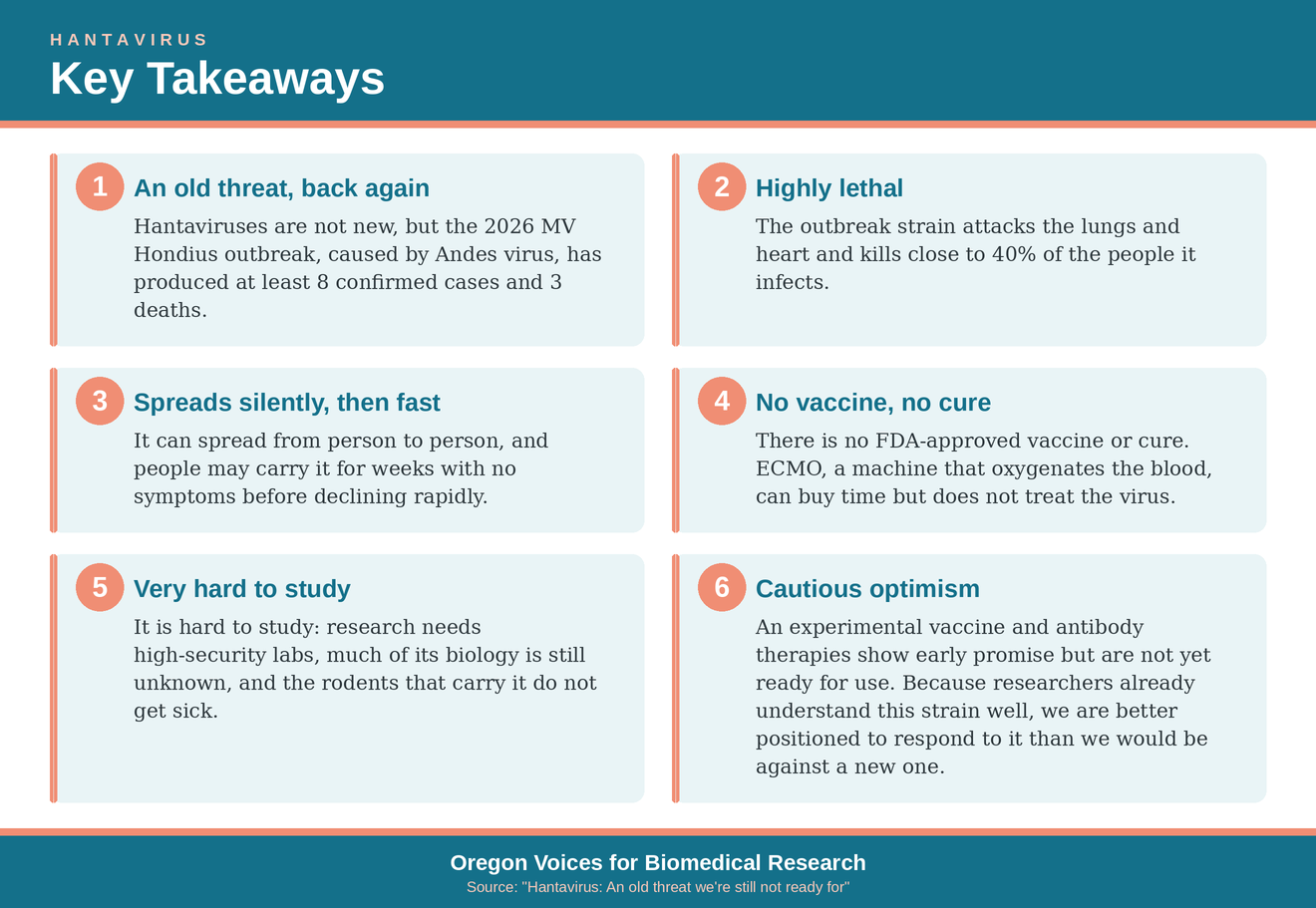
Rodent-borne hantaviruses have likely been causing disease in humans for centuries. Descriptions of what may be hantavirus-related illness appear in Chinese texts from 960 A.D., and clinicians documented “trench nephritis” during World War I and Korean Hemorrhagic Fever during the Korean War. More recently, an outbreak at Yosemite’s Curry Village in 2012 killed 3 people. Now, in 2026, a new outbreak has captured the world’s attention as at least 8 confirmed cases of hantavirus have been linked to passengers aboard the MV Hondius, and 3 people have died. So what are hantaviruses, and why are researchers and public health officials concerned?
Hantaviruses fall into two broad groups based on pathology and geographic distribution:
- Old World hantaviruses, including Hantaan, Puumala, Seoul, and Dobrava, are found primarily in Europe and Asia. They cause Hemorrhagic Fever with Renal Syndrome, a disease that causes kidney failure and kills 1-15% of those infected.
- New World hantaviruses, primarily Sin Nombre and Andes virus (the species linked to the current outbreak), are found in the Americas. They cause Hantavirus Cardiopulmonary Syndrome (HCPS), a disease characterized by rapid onset of pulmonary edema and shock, with a case fatality rate approaching 40%.
While hantavirus cases are still relatively rare, there is significant potential for these viruses to cause a pandemic-level outbreak, and we are woefully unprepared to address outbreaks, as evidenced by the current outbreak.
Three things make these viruses particularly concerning:
- The incubation period is long and patients can be asymptomatic for up to 8 weeks, allowing the virus to spread undetected.
- Typically patients present with a prolonged febrile phase, and then rapid respiratory decline, making diagnosis difficult until it is too late.
- Andes, the current outbreak strain, has been shown to spread person to person through respiratory transmission.
There are no FDA-approved vaccines or treatments for hantavirus disease. For patients with severe disease, the treatment is extracorporeal membrane oxygenation (ECMO), in which blood is routed through an external machine that oxygenates it before returning it to the body. It is an extraordinary measure, not a cure.
Why don’t we have anything better to offer the individuals affected by this virus? Hantaviruses are difficult to work with for several reasons:
- The virus is dangerous and surrogates don’t always work. Depending on the species, hantavirus research requires Biosafety Level 3 or 4 containment, meaning researchers work in pressurized suits and follow strict decontamination protocols, which substantially slows down research. There are ways to make safer “surrogate” systems that look and act like the virus, but cannot cause harm to humans or replicate. Unfortunately, these surrogates do not fully recapitulate the native virus, so their usefulness is limited, and true drug and vaccine development has to ultimately occur in high containment.
- There is still so much biology we don’t understand. Hantaviruses cause a hemorrhagic fever, meaning they make your blood vessels more permeable, causing fluid to accumulate in areas such as the lungs and kidneys. However, it remains unclear whether this damage is caused directly by the virus or by an overactive immune response. If we cannot understand how the virus impacts the body, it is substantially more difficult to treat. Until recently, the three-dimensional structure of the hantavirus surface protein was also unknown, which is necessary to rationally design therapeutics and vaccines. Finally, the best way to protect against viruses is to prevent them from entering your cells. However, we still have a limited understanding of how these viruses engage with and enter host cells, hindering our ability to block this process.
- There are almost no usable animal models. Hantaviruses and rodents have co-evolved over millions of years, and the virus causes no disease in its natural rodent hosts. Since most preclinical research relies on rodent models, this creates a fundamental problem in which the most commonly used laboratory animals are the least likely to get sick. The Syrian golden hamster infected with Andes virus is currently the only well-validated model that reproduces the respiratory failure seen in humans. A modified version using immunosuppressed hamsters has been developed for Sin Nombre virus, but requires artificially disabling the immune system to make disease manifest and is not a robust model. Non-human primate models exist but are limited in scale; marmosets have shown some promise for modeling Old World hantavirus infection, though even these have not successfully reproduced the kidney failure observed in humans.
While research has been difficult, we have made significant progress towards vaccines and therapeutics. The most advanced vaccine platform, developed by USAMRIID, uses DNA encoding the hantavirus surface protein to train the immune system, similar to the mRNA-encoded COVID-19 vaccines. Phase I clinical trials of a combined Hantaan/Puumala DNA vaccine delivered by intramuscular electroporation have demonstrated safety and durable neutralizing antibody responses. A key technical challenge in hantavirus vaccine design is that the surface proteins recognized by the immune system form complex tetrameric structures composed of two proteins arranged in repeating units of four. Accurately reproducing this geometry in a synthetic vaccine is difficult but essential for generating a protective immune response.
Instead of teaching your body how to fish with a vaccine, it is also possible to just provide the “fish” in the form of monoclonal antibody therapies. Multiple groups have mined the blood of individuals that have survived hantavirus infection to find the best, most protective antibodies. Luckily, an intrinsic property of some of the best antibodies is that they work across multiple hantavirus species, covering the whole family and providing broad protection. These antibodies have shown broad protection in animal models of disease, but have not been developed further. In theory, antibodies could be given to exposed individuals and may prevent them from spreading the virus to other individuals, although clinical trials to support efficacy have not been conducted.
Nearly fifty years after the first hantavirus was isolated, there are still no approved drugs or vaccines for hantavirus disease in the United States. The current outbreak involves Andes virus, the species that has received the most research attention and, luckily, the outbreak strain has little divergence from laboratory strains. But the hantavirus family is large, rodents are everywhere, and spillover events will continue. If a future strain carrying mutations that enhance transmissibility or immune evasion emerged, we could be caught flat-footed. The MV Hondius outbreak should be a warning: we have benefited from the relatively known biology of Andes virus, not from any strength in our pandemic preparedness. That may not be true next time.