Nearly half of all pregnancies in the U.S. are unintended. The most effective methods of birth control rely on synthetic hormones, and concern about side effects is the number one reason women stop using contraception or never start. We need fundamentally new options, and to get there, we need better research tools.
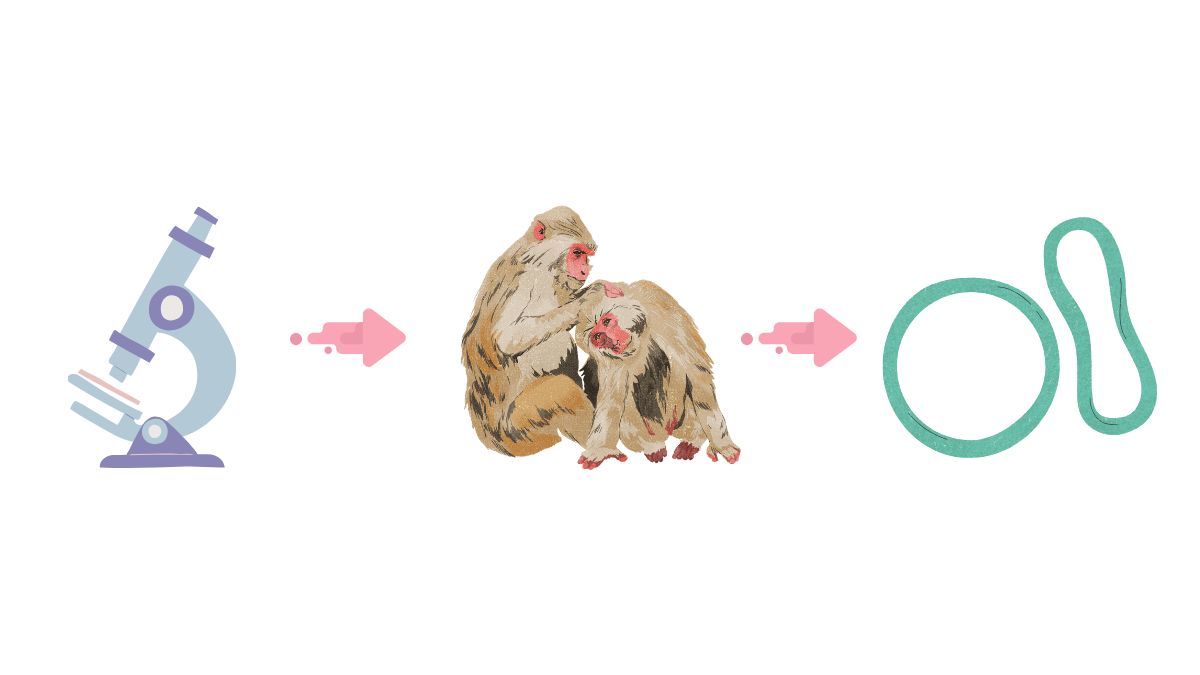
One lab at the Oregon National Primate Research Center (ONPRC) is focused on building those tools. They’re developing two complementary platforms to accelerate nonhormonal contraceptive discovery: a cell-based model that allows researchers to study the cervix in the lab, and a primate model that lets them test whether new drug candidates are safe and actually work in a living body.
Why The Cervix?
Cervical mucus is one of the body’s most powerful natural regulators of fertility. For most of the menstrual cycle, the mucus lining the cervical canal is thick and sticky. Sperm can’t get through. Then, for a few days around ovulation, hormones trigger a dramatic shift, and the mucus becomes thin, watery, and permeable, giving sperm a window to swim into the upper reproductive tract.
Every hormonal contraceptive on the market, from the pill to the hormonal IUD, works in part by keeping that mucus in its thick, sperm-blocking state. The question driving this research is: can it achieve the same effect without hormones?
If the specific molecular pathways, such as ion channels and other cellular machinery that control mucus quality, can be identified, then it could be possible for researchers to design drugs that act directly on the cervix. Local delivery through something like a vaginal ring would mean minimal drug absorption into the rest of the body and, hopefully, far fewer side effects than current hormonal methods.
A New Approach Methodology For Studying Cervical Mucus
One of the biggest obstacles in this field has been the lack of good laboratory tools. Cervical mucus is notoriously hard to study in people. It changes hour by hour during the cycle, sample collection is inconsistent, and researchers can’t easily control variables the way they need to for rigorous experiments.
To solve this, researchers at ONPRC built a New Approach Methodology (NAM): a primary cell culture system using endocervical epithelial cells from the rhesus monkey model. These cells are cultured on specialized membrane supports, where they develop distinct “top” and “bottom” surfaces, just like they have in the body. They secrete mucus. They respond to estrogen and progesterone. In short, they behave like a miniature cervix.
This system allows researchers to do things that are impossible in clinical studies:
- Screen drug candidates by treating cells and measuring changes in mucus hydration, thickness, and viscosity within hours
- Dissect molecular pathways by selectively blocking ion channels and other cellular targets to figure out which ones matter most for mucus regulation.
This NAM platform is supported by the National Institutes of Health (NIH) and the Bill & Melinda Gates Foundation.
The Primate Model: Why It Matters
Cell culture gets the science far, but eventually scientists need to know whether a drug works in a real reproductive tract with real mucus and real sperm. This is where the monkey model becomes essential.
Most common lab animals, mice and rats, don’t have a glandular, mucus-secreting cervix. They don’t menstruate. The changes in cervical mucus that define fertility in women simply don’t exist in rodent models. Primates are the only animals that share this biology with us, making them the only relevant model for testing contraceptives that target the cervix.
At the ONPRC, researchers built a primate testing platform in baboons and rhesus macaques that includes:
- An artificial cycle model that uses hormone replacement to generate fertile-quality mucus on a predictable schedule, eliminating the variability that makes natural cycle experiments unreliable
- Clinical mucus scoring adapted from human fertility assessment, measures properties like stretchiness, ferning patterns, and viscosity.
- Post-coital testing, which is the gold-standard method for evaluating whether sperm can penetrate cervical mucus after drug treatment. In our model, we can inseminate with a precise sperm dose and collect mucus samples under controlled conditions, something that is nearly impossible to standardize in human clinical trials.
- Tissue and blood sampling to compare how much drug stays local versus how much enters the bloodstream
Using these tools in NIH-funded studies, these researchers have shown that vaginally administered drugs targeting ion channels in cervical cells can rapidly convert fertile mucus into a thick, sperm-blocking barrier and that post-coital testing in primates confirms the effect. Next steps are to work toward the delivery of promising drug candidates through an intravaginal ring designed for sustained, month-long protection.
Two Platforms, One Goal
The NAM and the primate model work hand in hand. The cell system lets us screen and refine. The primate model lets us validate. Together, they give researchers a pipeline to move nonhormonal contraceptive candidates from concept to the clinic, efficiently and humanely.
If successful, this approach could lead to the first genuinely new mechanism of birth control in decades: a locally acting, hormone-free method delivered in a format women already know and trust.
The ONPRC is one of the few centers with the infrastructure, expertise, and integrated resources required to carry this work forward.
Learn More
Selected publications and reporting on the research described above:
- Han, L., Andrews, W., Wong, K., & Jensen, J. T. (2020). Conditionally reprogrammed macaque endocervical cells retain steroid receptor expression and produce mucus. Biology of Reproduction, 102(6), 1191-1202. https://doi.org/10.1093/biolre/ioaa039
- Han, L., Padua, E., Edelman, A., & Jensen, J. T. (2018). Appraising cervical mucus: A new approach to evaluating contraceptives. The European Journal of Contraception & Reproductive Health Care, 23(1), 78-83. https://doi.org/10.1080/13625187.2018.1437134
- Han, L., Roberts, M., Luo, A., Wei, S., Slayden, O. D., & Macdonald, K. D. (2022). Functional evaluation of the cystic fibrosis transmembrane conductance regulator in the endocervix. Biology of Reproduction, 107(3), 732-740. https://doi.org/10.1093/biolre/ioac090
- Han, L., Taub, R., & Jensen, J. T. (2017). Cervical mucus and contraception: What we know and what we don’t. Contraception, 96(5), 310-321. https://doi.org/10.1016/j.contraception.2017.07.168
- Looney, R. J., Roberts, M., Markovetz, M., Godiah, R., Yao, S., Golgotiu, K., Wei, S., Cellucci, C., & Han, L. (2025). In vitro inhibition of the CFTR ion channel in the Macaca mulatta cervix thickens cervical mucus. Biology of Reproduction, 113(4), 803-810. https://doi.org/10.1093/biolre/ioaf103
- Rapp, K., Wei, S., Roberts, M., Yao, S., Fei, S. S., Gao, L., Ray, K., Wang, A., Godiah, R., & Han, L. (2024). Transcriptional profiling of mucus production in rhesus macaque endocervical cells under hormonal regulation. Biology of Reproduction, 111(5), 1045-1055. https://doi.org/10.1093/biolre/ioae121
- Yeager, A. (2025, January 13). Researchers create lab model that could lead to new, non-hormonal birth control methods. OHSU News. https://news.ohsu.edu/2025/01/13/researchers-create-lab-model-that-could-lead-to-new-non-hormonal-birth-control-methods