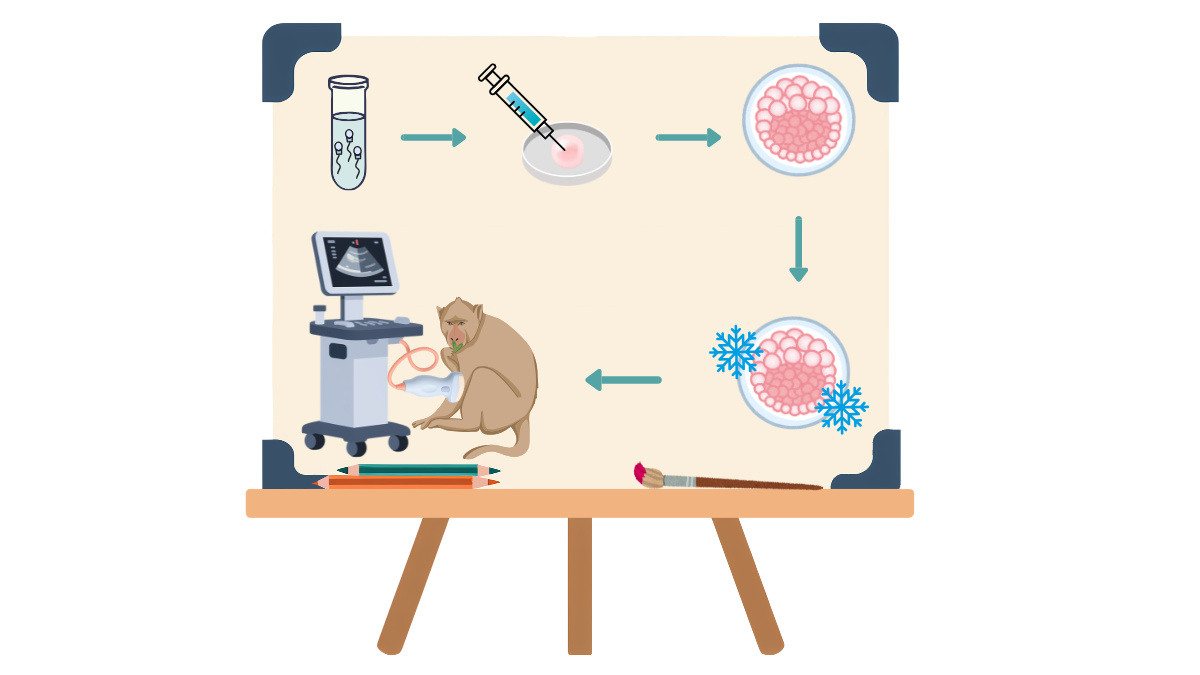
Diagram of the ART process (Following the arrows from the top left to the bottom: semen collection, IVF/ICSI, blastocyst development and collection, vitrification (freezing/preserving embryos), embryo transfer and pregnancy monitoring)
When most people hear the word “art”, the first thing that comes to mind is a painting, a sculpture, or anything creative produced by an artist. Interestingly, for the scientists at the Oregon National Primate Research Center (ONPRC) “ART” Core, the first thing that comes to their mind is an egg, a sperm cell, or an embryo.
“And why is that?” you might ask. Well, the acronym “ART” stands for Assisted Reproductive Technologies.
What Kind of “ART” Are These Scientists Doing?
One of the most interesting things the ART Core does is support the development of nonhuman primate models for different diseases. Below are a few examples of models generated at the ONPRC ART Core:
- Usher’s Syndrome: a genetic disorder that causes hearing loss, vision loss (retinitis pigmentosa), and, in some cases, balance issues. This disease does not naturally occur in rhesus macaques, so the ART Core team generated a model using a gene editing technology called CRISPR.
- Bardet-Biedl Syndrome (BBS): a genetic disease that can affect many different organs, with symptoms ranging from vision loss (retinal degeneration), obesity, kidney abnormalities, learning disabilities, and many others. This disease was found to occur naturally in rhesus monkeys at the ONPRC, much to the researchers’ surprise. With the help of the ART Core team, researchers can identify individuals affected by this mutation and try to develop a treatment that could help both humans and monkeys.
- Hepatitis B: a disease caused by the Hepatitis B Virus (HBV) that can lead to severe liver damage, possibly resulting in cirrhosis, liver failure, or liver cancer. Since rhesus monkeys are not naturally susceptible to this virus, the ART Core team generated a model that expresses the human receptors in their liver. This resource will help researchers develop ways to prevent and/or treat the disease in newborn babies, who typically develop chronic hepatitis B when infected during birth.
The development of these models requires the use of several ARTs, including:
- Cooperative semen collection: Males are trained through positive reinforcement to voluntarily enter a box chair and provide a semen sample.
- Controlled Ovarian Stimulation (COS): In a similar process to humans, female monkeys receive hormones to stimulate the growth of multiple follicles in their ovaries, with the goal of obtaining mature oocytes (eggs) for in vitro studies.
- Ultrasound-guided follicle aspiration: This is a non-invasive method for retrieving eggs from stimulated ovaries.
- In Vitro Fertilization (IVF) or Intracytoplasmic Sperm Injection (ICSI): A process of introducing sperm into mature eggs to produce embryos in vitro.
- Embryo culture: After fertilization, embryos are kept in a special nutrient solution (culture medium) in a controlled environment that supports embryo development.
- Trophectoderm biopsy: Once embryos reach the blastocyst stage (when they are ready to implant in the uterus), specialized equipment, including micromanipulators and a laser, is used to remove a small piece of the embryo (biopsy) that will be analyzed to check for the correct genetic profile.
- Embryo vitrification: After biopsy, embryos are frozen using a technique called vitrification. Vitrified embryos are stored in liquid nitrogen dewars and can be thawed when they are ready to be used. This is a similar process to how embryos are stored for people in family planning/fertility treatments.
- Embryo transfer: Consists of placing an embryo inside the uterus or fallopian tube. In humans, the embryo is transferred into the uterus by way of a catheter inserted through the cervix. In rhesus monkeys, however, this is typically done surgically because inserting a catheter can be difficult, as the pathway through their cervix twists and bends.
- Pregnancy and delivery monitoring: About 30 days after an embryo transfer, an ultrasound is performed to check for pregnancy. If the female is found to be pregnant, she is monitored by ultrasound throughout pregnancy to ensure both mom and baby are doing well. About 10 days prior to the expected delivery date (165 days of pregnancy), the mom is monitored daily by video to ensure she can safely deliver her baby.
The ONPRC ART Core Team is highly invested in the welfare of their monkeys. Because of that, they work closely with all teams involved in the care of the animals (e.g., Behavioral Team, Veterinary Team, Surgical Team, and Animal Husbandry Team) to ensure the animals are comfortable and healthy and that all their needs are met. Moreover, the ART Core team is always looking for ways to refine its techniques to minimize stress and reduce the impact these procedures may have on the animals.
Learn More
Want to go deeper? Each disease model below is documented in peer-reviewed research and has been covered by OHSU, the independent science press, and the patient communities these models could help. Follow the links to read the stories and the studies.
Usher’s Syndrome
- OHSU News: OHSU confirms first nonhuman primate model of Usher syndrome (2023)
- Drug Target Review: Usher syndrome, first nonhuman primate model (2023)
- Usher Syndrome Coalition: USH1B research overview
- Ryu J, Statz JP, Chan W, et al. CRISPR/Cas9 editing of the MYO7A gene in rhesus macaque embryos to generate a primate model of Usher syndrome type 1B. Scientific Reports. 2022;12:10036. doi:10.1038/s41598-022-13689-x (PMID: 35710827)
Bardet-Biedl Syndrome (BBS)
- OHSU News: Discovery in monkeys could lead to treatment for blindness-causing syndrome (2019)
- The Ophthalmologist: “Monkey See?” (2020)
- Peterson SM, McGill TJ, Puthussery T, et al. Bardet-Biedl Syndrome in rhesus macaques: A nonhuman primate model of retinitis pigmentosa. Experimental Eye Research. 2019;189:107825. doi:10.1016/j.exer.2019.107825 (PMID: 31589838)
Hepatitis B
- OHSU News: OHSU scientists develop first transgenic model for hepatitis B research (2025)
- Contagion Live: New Transgenic Rhesus Macaque Model Paves Way for HBV Therapy Development (2025)
- Rust LN, Wettengel JM, Biswas S, et al. Liver-specific transgenic expression of human NTCP in rhesus macaques confers HBV susceptibility on primary hepatocytes. Proceedings of the National Academy of Sciences. 2025;122(7):e2413771122. doi:10.1073/pnas.2413771122 (PMID: 39937851)